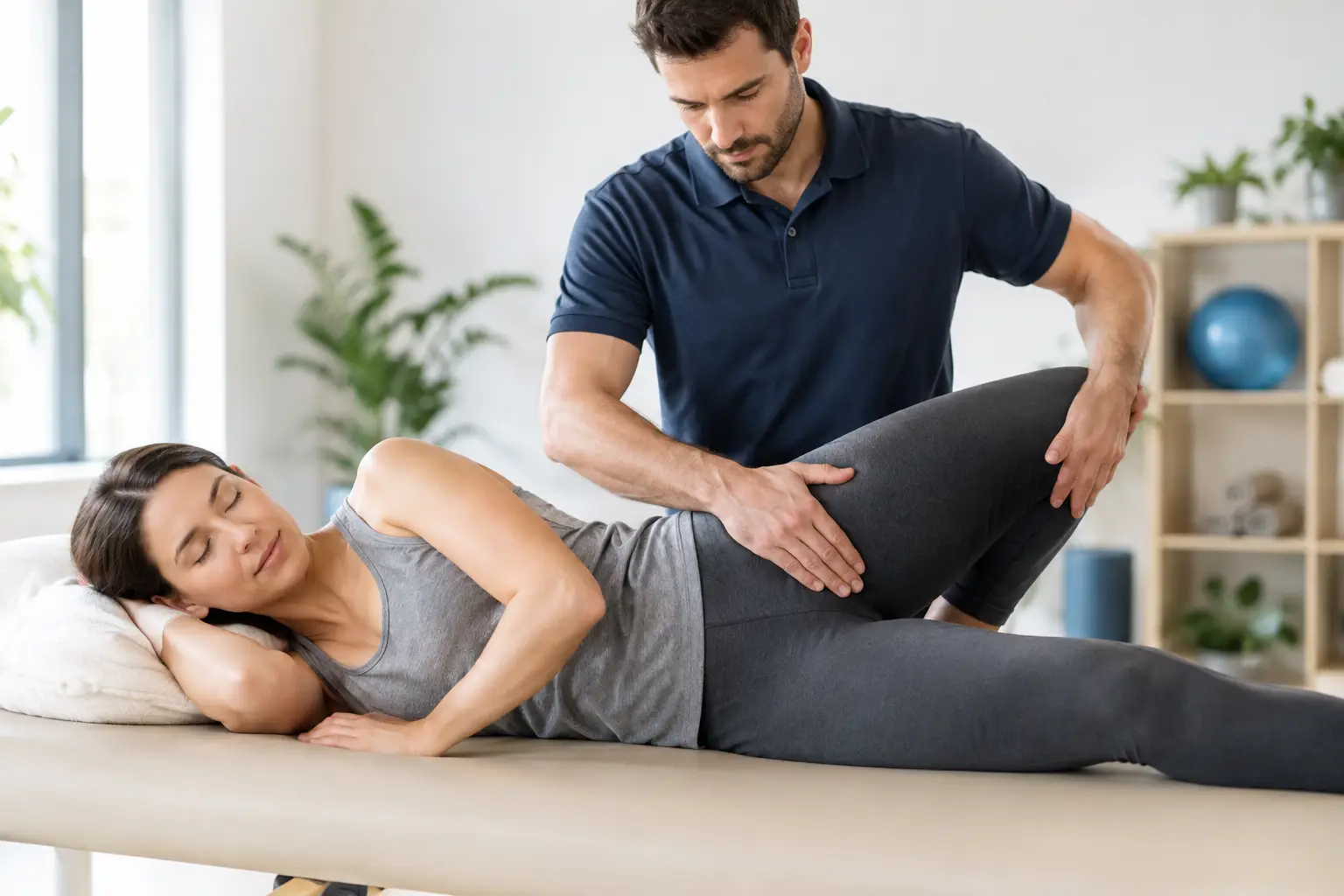
A hip that feels tight is not always a hip that needs to be stretched harder. It may feel restricted after a long workday, a heavy training block, an old injury, or a period of stress when your body has been bracing without much rest. The goal of an improve hip mobility massage approach is not to force range of motion. It is to understand what is limiting comfortable movement, then use treatment that your body can tolerate and use.
For many people, the most useful outcome is not an impressive stretch at the end of an appointment. It is walking upstairs with less pulling at the front of the hip, getting out of a chair more easily, returning to a squat with greater control, or feeling less guarded during a run. Those changes often come from a combination of hands-on therapy, movement, and a nervous system that feels safe enough to stop protecting the area so intensely.
Why hip mobility is more than flexibility
Hip mobility describes how comfortably and controllably the hip joint moves through its available range. Flexibility is part of that picture, but it is not the whole picture. A person may have plenty of passive range when someone else moves their leg, yet still feel stiff or unstable when climbing, lunging, or changing direction.
The hip is influenced by the lower back, pelvis, abdominal wall, glutes, thighs, and even the foot and ankle. Sitting for long periods can leave the front of the hip feeling compressed. Training volume can make the glutes, adductors, or hip flexors feel overworked. Back pain, previous injury, poor sleep, and stress can all change muscle tone and movement choices.
That is why a one-size-fits-all “hip opener” is not always helpful. Aggressive stretching may irritate an already sensitive front hip or create more guarding afterward. If the limitation is partly due to poor control, joint irritation, or a protective nervous system response, more intensity is not necessarily more effective.
What massage can and cannot do for hip mobility
Massage therapy can reduce the sense of tightness, address tender or overactive tissues, and help you move with less discomfort. Manual therapy may be directed toward the glutes, hip flexors, adductors, quadriceps, hamstrings, lower back, or the connective tissue that links these areas. Techniques may include myofascial release, trigger point therapy, Swedish-style work, and focused deep tissue treatment when appropriate.
The benefit is often partly mechanical and partly neurological. Touch, pressure, and slow, well-tolerated movement can give the brain new information about the area. When the body perceives less threat, it may allow more comfortable motion. This does not mean massage “breaks up” tissue or permanently lengthens a muscle in one session. It means treatment can create a useful window for movement, recovery, and retraining.
Massage cannot diagnose every cause of hip pain or replace medical assessment when it is needed. It also cannot reliably change structural conditions such as advanced osteoarthritis, a labral tear, or significant joint impingement on its own. Still, it can be a meaningful part of conservative care when the goal is to manage symptoms, improve movement tolerance, and support an active life.
A clinical assessment guides the treatment
An effective hip-focused session starts before hands-on work. Your therapist may ask when the restriction began, which movements provoke it, how training or work has changed, and whether symptoms travel into the back, groin, buttock, or leg. They may also observe comfortable movement patterns such as a squat, hip rotation, walking, or getting on and off the table.
This assessment matters because the location of discomfort does not always reveal the source. A pinching sensation at the front of the hip may involve local hip flexor sensitivity, but it may also be influenced by pelvic position, lumbar stiffness, or how the glutes are sharing load. Lateral hip discomfort may be related to the tissues around the outer hip, but pressure directly over a sensitive area is not automatically the best first choice.
At Reset Registered Massage Therapy, treatment is adjusted throughout the appointment rather than following a fixed sequence. Your response matters: whether pressure feels relieving or sharp, whether your breathing changes, and whether a technique improves movement afterward. That collaborative process supports more precise care and helps keep treatment within a useful, safe tolerance.
Areas that may be included in a hip mobility massage
A hip mobility treatment rarely means working only on the hip. Depending on your assessment, your therapist may include the lower back and sacral region, glutes and deep external rotators, inner thigh muscles, quadriceps, hamstrings, or the lower leg. The goal is to address the movement system around the hip without assuming every nearby muscle needs intense pressure.
Front-of-hip tightness
When the front of the hip feels crowded or stiff, treatment may include the upper quadriceps, surrounding hip flexor region, abdominal wall, and tissues that influence pelvic movement. Direct work around the hip flexors requires thoughtful positioning, clear consent, and ongoing communication. This region can feel vulnerable for many clients, and a trauma-informed approach means you remain in control of pressure, positioning, and whether an area is treated at all.
Glute and outer-hip tension
Gluteal muscles help control the pelvis during walking, stairs, running, and single-leg tasks. When they are overloaded, people may describe a deep ache in the buttock, a pulling sensation along the outer hip, or stiffness after sitting. Targeted work can be useful, but deeper is not always better. Slow pressure, broad contact, and movement-based reassessment often provide more value than trying to force a painful release.
Inner-thigh and rotational restrictions
Adductors can contribute to the feeling that the legs will not comfortably widen, rotate, or settle into a squat. They may be challenged by cycling, court sports, lifting, or compensation after an injury. Treatment in this area should be clinically indicated and consent-led. For some clients, gentler work combined with active movement is more productive than sustained deep pressure.
Why nervous-system regulation belongs in hip care
A hip can feel “tight” because the tissues are working hard, but also because the nervous system is on alert. Persistent pain, demanding schedules, anxiety about reinjury, and insufficient recovery can increase protective muscle tone. In that state, a forceful treatment can feel overwhelming and may leave the area more reactive.
A nervous-system-aware massage uses pacing, breath, positioning, and pressure that meet you where you are. Sometimes a calming Swedish-style approach creates the best conditions for deeper therapeutic work. Other times, focused orthopaedic or sports massage is appropriate. The right balance depends on your symptoms, goals, health history, and how your body responds that day.
This is especially relevant if you have had painful treatment experiences in the past. Effective care does not require gritting your teeth. Productive sensation should remain communicable, tolerable, and responsive to adjustment.
Make the results more useful between appointments
Massage tends to work best when the relief it creates is followed by low-threat movement. After a session, your therapist may suggest a simple mobility drill, a short walk, or a controlled strength exercise that matches your presentation. The purpose is not to give you a long homework list. It is to help your body practice the movement that just became easier.
For desk-based professionals, brief position changes throughout the day can matter more than one intense stretch at night. For runners, lifters, and recreational athletes, hip symptoms often respond better to sensible load adjustments than to complete rest or repeated aggressive stretching. If a movement consistently produces sharp pinching, catching, numbness, or escalating pain, it deserves further assessment rather than repeated self-treatment.
When hip stiffness needs medical attention
Seek medical evaluation promptly if hip symptoms follow a significant fall or trauma, if you cannot bear weight, or if you have fever, unexplained swelling, severe unrelenting pain, or new bowel or bladder changes. Numbness, progressive weakness, and pain that travels strongly down the leg also warrant timely assessment.
For ongoing symptoms, consider a coordinated plan when pain is not improving, sleep is regularly disrupted, or your mobility is steadily declining. Massage therapy can work alongside primary care, physiotherapy, and other appropriate providers. The goal is not to prove one method is best, but to choose care that fits the problem and supports your capacity to move.
Your hips do a remarkable amount of quiet work each day. Giving them thoughtful attention – with assessment, consent, appropriate pressure, and movement that feels doable – can make the next walk, workout, commute, or restful night feel more like your own again.