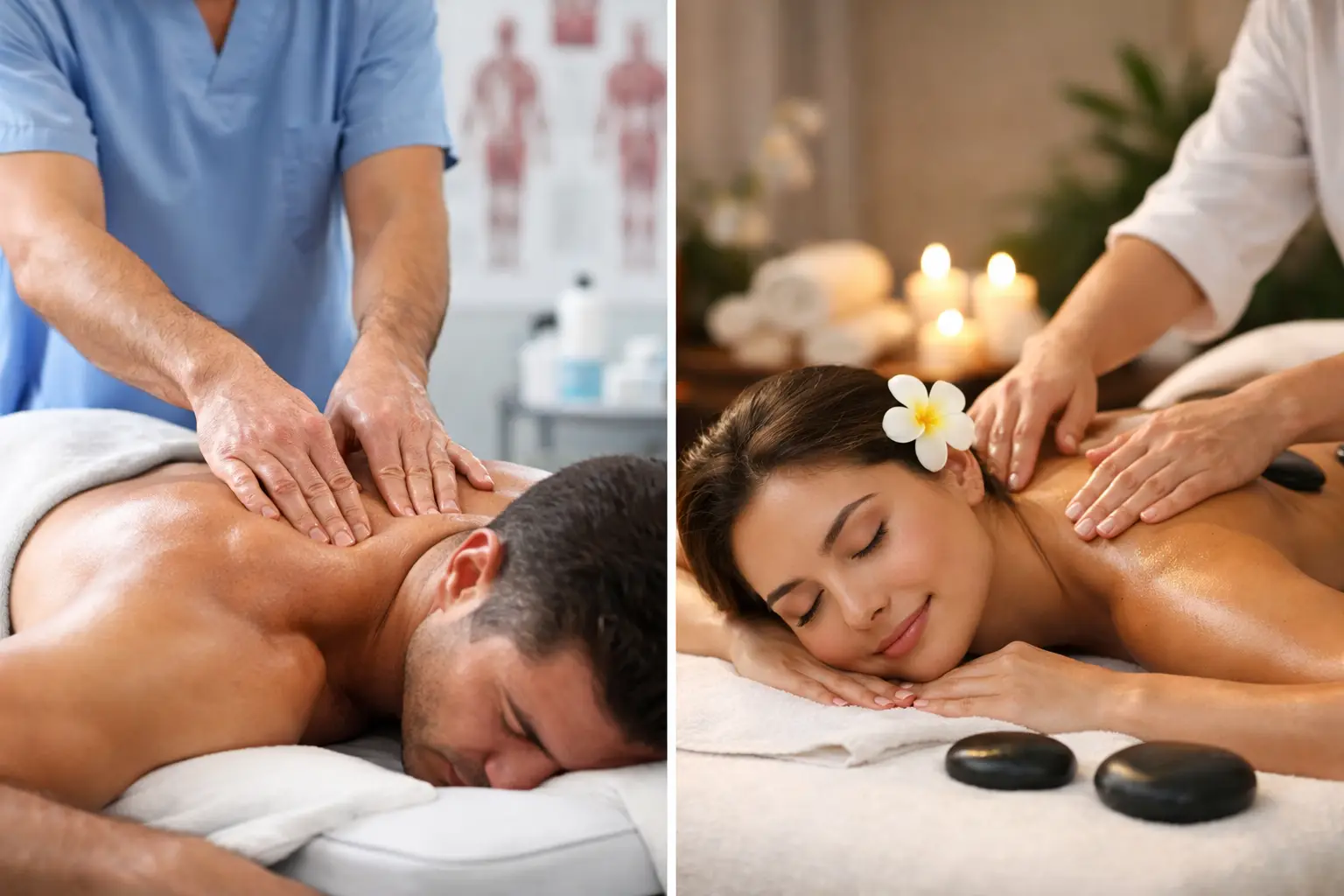
A lot of people realize they booked the wrong kind of massage only after they are already on the table. They wanted help with jaw tension, a stubborn shoulder, post-workout hip tightness, or stress that has settled into the body – but the session they booked was built more for general relaxation than targeted treatment. That is where understanding clinical massage versus spa massage becomes useful.
Both can feel good. Both can reduce tension. But they are not designed for the same purpose, and the difference matters if you are dealing with pain, restricted movement, recurring headaches, injury recovery, or a nervous system that feels stuck in high alert.
Clinical massage versus spa massage: the real difference
The clearest distinction is the treatment goal. A spa massage is usually organized around comfort, relaxation, and a consistent full-body experience. A clinical massage is organized around assessment, intent, and measurable change. That does not mean clinical work has to feel cold or overly intense. It means the session is built around what your body actually needs that day.
In a spa setting, the experience is often standardized. You may choose a pressure level or a session length, but the structure tends to follow a familiar flow. That can be exactly right if your main goal is to unwind, rest, and enjoy soothing touch in a calm environment.
Clinical massage starts from a different place. The therapist looks at symptoms, movement patterns, aggravating factors, injury history, and tissue tolerance. Treatment may focus heavily on one area rather than the whole body. It may include orthopedic reasoning, reassessment during the session, and techniques selected for a specific outcome, such as reducing muscle guarding, improving range of motion, calming an irritated area, or supporting recovery from repetitive strain.
What happens in a clinical massage session
A true clinical session usually begins before hands-on work starts. There is intake, yes, but also clinical listening. Where does it hurt? When does it hurt? What makes it worse? What has already been tried? If raising your arm triggers pain at a certain angle, if your headaches start at the base of your skull, or if your low back tightens after commuting or lifting, those details shape the treatment plan.
From there, the therapist may use assessment of posture, movement, joint mechanics, or tissue response. The session itself may combine deep tissue work, myofascial release, trigger point therapy, Swedish-style relaxation, or gentler downregulating techniques depending on what your system can tolerate. Sometimes the most effective treatment is not the strongest pressure. Sometimes it is precise, calm, and paced in a way that lets the nervous system stop bracing.
That point is often missed. People hear “clinical” and assume aggressive. Good clinical massage is not about overpowering the body. It is about reading it accurately.
What a spa massage is designed to do well
Spa massage deserves a fair description, because it serves a real purpose. Relaxation is not trivial. For many people, a quieter, slower, whole-body session helps decrease stress, improve mood, soften generalized tension, and create a sense of reset. If you are not dealing with a specific injury or pain pattern, that may be all you need.
A spa massage can also be a better fit if your main priority is atmosphere and rest rather than focused therapeutic problem-solving. Some clients want a predictable experience with minimal conversation, broad soothing pressure, and an emphasis on comfort from start to finish. There is value in that.
Where it becomes less ideal is when someone expects it to function like targeted musculoskeletal care. If your problem is highly specific, recurring, or affecting daily function, a relaxation-first format may not go far enough.
When clinical massage is usually the better choice
If you have a clear complaint, clinical massage is often the more appropriate option. That includes neck and shoulder tension linked to desk work, sports-related overload, hip restriction, TMJ discomfort, tension headaches, chronic upper back tightness, or pain that keeps returning in the same pattern.
It is also a better fit when you want a practitioner to explain what they are finding and why they are treating a certain area. Many clients do not want a generic routine. They want to know why the calf is being treated for foot pain, why rib mobility matters for neck tension, or why relaxation work may be part of reducing chronic guarding. A clinical approach makes room for that reasoning.
This is especially important for people whose pain is stress-amplified. Muscles do not tense in isolation. Sleep, workload, previous injury, anxiety, and nervous-system sensitivity all change how the body responds to touch and load. An evidence-based, trauma-informed clinical massage should account for that, not ignore it.
Pressure is not the deciding factor
One of the most common misunderstandings in clinical massage versus spa massage is the idea that clinical means deep and spa means light. Pressure alone is not what separates them.
You can receive a very firm spa massage that still is not truly clinical, because it is not driven by assessment or a treatment objective. You can also receive a relatively gentle clinical massage that produces better results because it is specific, responsive, and appropriate for your tissue irritability.
For example, an acute flare-up, a sensitized jaw, or a body that has been bracing for weeks may respond poorly to heavy work. In that situation, thoughtful pacing and targeted treatment can outperform force. Effective care depends on dosage, timing, and precision, not just intensity.
The role of nervous-system safety
Massage quality is not only about technique. It is also about whether your body feels safe enough to respond.
For some clients, especially those living with chronic stress, burnout, persistent pain, or a history of feeling dismissed in healthcare settings, the environment matters almost as much as the hands-on work. Clear consent, collaboration, pressure checks, respect for boundaries, and a non-judgmental atmosphere are not extra touches. They are part of treatment quality.
That is one reason many clients prefer a clinical practice that is also warm and inclusive. The best results often come from sessions that blend musculoskeletal treatment with nervous-system downregulation. When your body is no longer fighting the process, it is easier to reduce guarding, improve movement, and get lasting relief instead of a few good hours followed by the same old tension.
How to choose the right type of massage for your goal
If your goal is to relax, de-stress, and enjoy a soothing full-body experience, spa massage may be the right choice. If your goal is to address a specific issue, understand why it keeps happening, and receive care that adapts to your symptoms and tolerance, clinical massage is usually the better fit.
It also helps to ask better questions before booking. Instead of asking only about pressure, ask whether the therapist assesses movement, whether treatment is customized to a complaint, whether the session can focus on one problem area, and whether the approach is appropriate for injury recovery or chronic pain patterns. Those answers tell you more than a menu description ever will.
For many people, the ideal care is not strictly one or the other. A strong clinical practice may include relaxation-based techniques because calming the system improves outcomes. That blend is often what people are actually looking for – treatment that is precise without feeling mechanical, and calming without being generic. At Reset Registered Massage Therapy, that combination is central to how sessions are designed.
Clinical massage versus spa massage for long-term results
The biggest trade-off is short-term comfort versus targeted change. A spa massage may leave you feeling peaceful and temporarily looser. A clinical massage aims for that plus something more specific: less pain with movement, fewer headaches, improved training tolerance, better shoulder mechanics, easier breathing, reduced jaw clenching, or a body that does not feel locked up by the end of the workday.
That does not mean every clinical session produces instant transformation. Bodies are more complex than that. Recovery depends on the issue, how long it has been present, your overall load, and how reactive the system is. But if your goal is measurable improvement, clinical care gives you a better framework for getting there.
The right massage is the one that matches the reason you are seeking care. If you want a pleasant hour, book for comfort. If you want a session built around your pain pattern, movement limits, and nervous-system response, choose a practitioner-led clinical approach that treats your body like it belongs to a real person, not a routine.