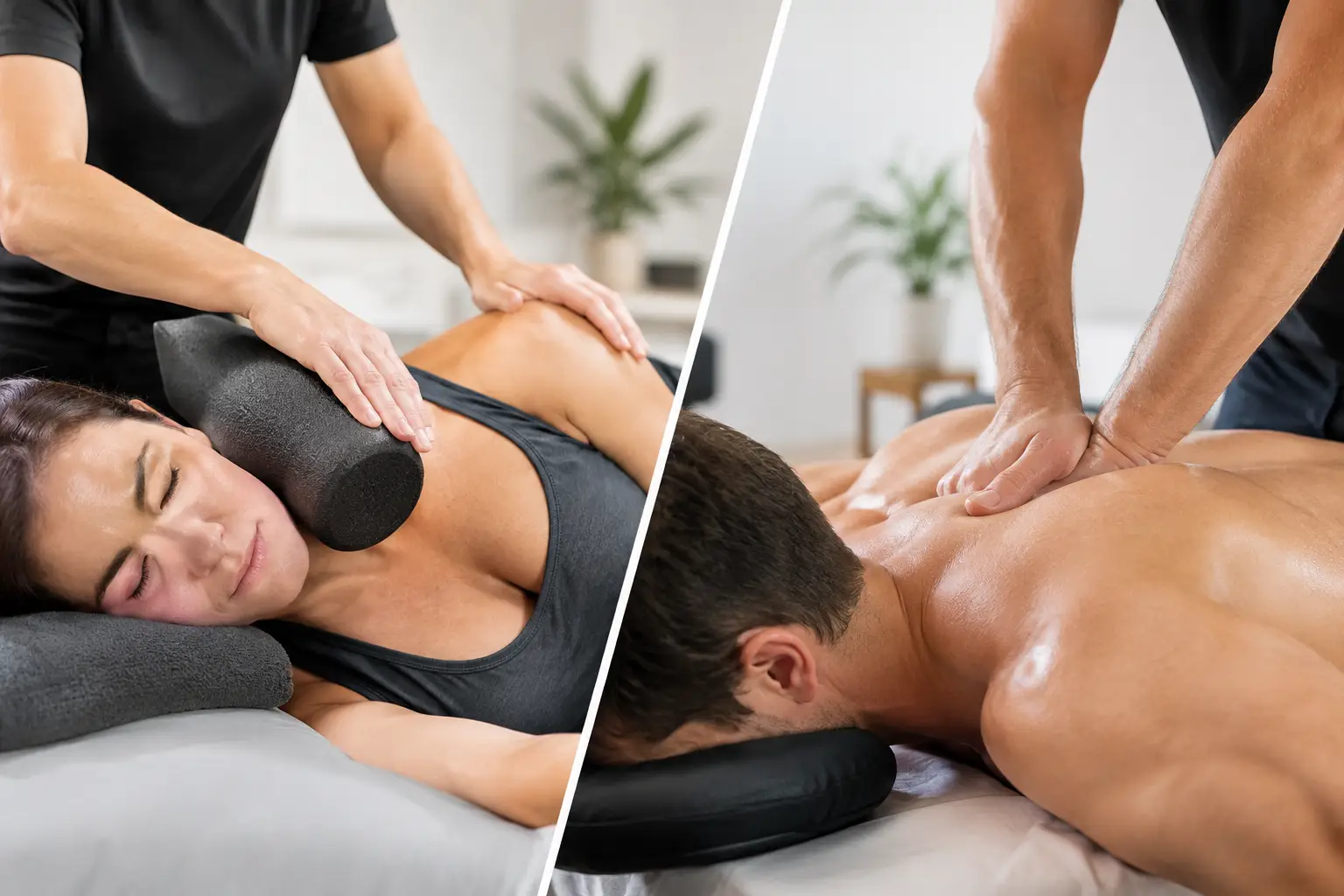
A shoulder that feels glued to your neck, a hip that tightens halfway through a run, or a jaw that aches after a demanding week can all create the same question: what kind of massage will actually help? In the conversation around myofascial release vs deep tissue, the answer is rarely about choosing the most intense option. It is about identifying what your body is responding to, what it can tolerate that day, and what supports meaningful change without leaving you braced for more.
At Reset Registered Massage Therapy, treatment starts with assessment and conversation rather than a preset routine. Myofascial release and deep tissue techniques can both be useful parts of registered massage therapy, but they work differently, feel different, and are not interchangeable.
Myofascial Release vs Deep Tissue: The Core Difference
Myofascial release generally uses sustained, attentive contact to work with fascia and the tissues around muscles. Fascia is connective tissue that surrounds and connects structures throughout the body. Rather than using fast or forceful pressure, an RMT may apply a slow stretch, gentle traction, or sustained pressure while monitoring how the tissue and your nervous system respond.
Deep tissue massage is a broad term for more focused work directed at deeper layers of muscle and other soft tissue. It may involve slower strokes, compression, stripping techniques, trigger point therapy, or targeted work around areas with persistent tension. It is often used when a client has a specific pattern such as upper back and shoulder tightness, restricted hip movement, post-training soreness, or a recurring area of muscular guarding.
The labels can be misleading. Deep tissue does not need to be painful, and myofascial release is not necessarily light. Both can range from gentle to firm depending on the technique, the location being treated, and your individual tolerance. A skilled treatment is not defined by how much pressure is used. It is defined by whether the pressure is purposeful, informed, and responsive to you.
What Myofascial Release May Feel Like
Myofascial work often feels slower and less dramatic than people expect. Your therapist may hold an area, gradually lengthen tissue, or invite small movements while maintaining contact. You may notice a feeling of spreading warmth, a softening around a joint, or a gradual change in how freely you can breathe or move.
This approach can be especially appropriate when your body feels protective or sensitized. If you have chronic pain, stress-related tension, frequent headaches, TMJ discomfort, or a history of feeling worse after aggressive massage, slower manual therapy can create room for change without asking your system to push through alarm signals.
That does not mean fascia needs to be forcibly “broken up.” Healthy tissue is not a knot of material that requires painful pressure to be repaired. Current evidence supports a more measured view: manual therapy may help modulate pain, improve short-term comfort and movement, and provide useful sensory input. The effects likely involve the nervous system, circulation, tissue tolerance, and the context of care, not simply a mechanical release of adhesions.
What Deep Tissue Massage May Feel Like
Deep tissue work is usually more localized. If your forearm has been overloaded from climbing, your glutes are working overtime during long runs, or your upper traps are constantly elevated at a desk, treatment may focus on those patterns with firmer pressure and more specific contact.
A therapeutic level of intensity can feel productive, but it should remain tolerable. Some tenderness is normal when working with sensitive tissue. Sharp pain, breath-holding, involuntary bracing, numbness, tingling, or the sense that you need to endure the session are signs to speak up. More pressure is not automatically more effective, and soreness the next day is not proof that treatment worked.
For some clients, deeper work can temporarily reduce the sensation of tightness and make movement feel easier. For others, particularly during periods of high stress, poor sleep, acute injury, or pain sensitivity, aggressive pressure may increase guarding and leave them feeling depleted. The right dose depends on the person, not the marketing label.
Which Approach Is Better for Pain and Tightness?
Neither modality wins across the board. A person with a restricted-feeling shoulder may benefit from focused deep tissue work in the chest, upper back, or rotator cuff region, combined with myofascial techniques that address movement and comfort through the neck and rib cage. Someone with persistent tension headaches may need gentler work around the jaw, scalp, neck, and breathing mechanics rather than heavy pressure into already irritated muscles.
A useful clinical question is not, “Where is the tightest spot?” It is, “What is this area doing, and what is contributing to the pattern?” Tightness can reflect training load, repetitive work, limited recovery, joint irritation, stress, protective muscle activity, or a combination of factors. Massage therapy can be part of a plan for symptom relief and function, but it works best when the treatment matches the underlying presentation.
When Myofascial Release May Be a Good Starting Point
Myofascial release may be a strong fit if your symptoms are diffuse, long-standing, or closely tied to stress and nervous-system overload. It can also be useful if direct pressure has felt overwhelming in the past, if you are returning to care after a flare-up, or if you want treatment that balances physical change with deep downregulation.
The slower pace creates opportunities for feedback. Your therapist can assess whether your range of motion changes, whether pressure feels safe, and whether your body is settling or becoming more guarded. This is particularly valuable in trauma-informed care, where consent, predictability, and client choice are central to treatment quality.
When Deep Tissue Work May Be a Good Fit
Deep tissue techniques may be appropriate when there is a clear, localized issue and you generally respond well to firmer contact. Athletes managing training load, commuters with recurring upper-back discomfort, and clients with muscular tension around the hips or shoulders may find targeted work helpful as part of a broader treatment plan.
It can be especially useful when combined with reassessment. For example, an RMT may check a squat, neck rotation, shoulder reach, or hip movement before and after treatment rather than relying only on how the area feels under pressure. That keeps the session focused on function, not just intensity.
Why Personalization Matters More Than the Modality
Massage is not a menu item where one technique is always superior. A high-quality session may blend orthopaedic assessment, Swedish-style relaxation, myofascial release, trigger point therapy, and focused deep tissue work in different proportions. The plan should change based on your goals, health history, current symptoms, training schedule, stress level, and response during the appointment.
Communication is part of the treatment. You should be able to ask for less pressure, more pressure, more explanation, less conversation, a different position, or a pause at any point. A safe, non-judgmental, inclusive environment is not separate from clinical care. It helps your nervous system receive treatment with less guarding and makes it easier to provide the feedback your therapist needs.
There are also times when massage should be modified or postponed. New unexplained pain, significant swelling, fever, recent fracture, suspected blood clot, active infection, or neurological symptoms such as new weakness or numbness warrant medical assessment. An RMT can help determine whether treatment is appropriate and adapt techniques when there are health considerations.
What to Ask Before Your Appointment
If you are unsure where to start, you do not need to arrive with the correct modality selected. Describe what you notice: when symptoms began, what movements aggravate them, what provides relief, how your sleep and stress have been, and what past treatments felt helpful or unhelpful. If your goal is to relax while addressing a specific concern, say that too.
You might also ask how the therapist will assess your concern, what level of pressure they recommend, and how they will adjust if your body becomes more sensitive. Clear answers are a good sign that treatment will be collaborative rather than formulaic.
The most useful massage is often the one that leaves you feeling more at ease in your body, with a clearer sense of what it needs next. Whether that involves sustained myofascial release, focused deep tissue work, or a thoughtful combination of both, your comfort and response should guide the session.