You know the feeling: your neck is “tight,” your jaw is clenched, your shoulders sit up by your ears – and even after you stretch, the tension comes right back. That pattern is often less about a stubborn muscle and more about an overprotective nervous system.
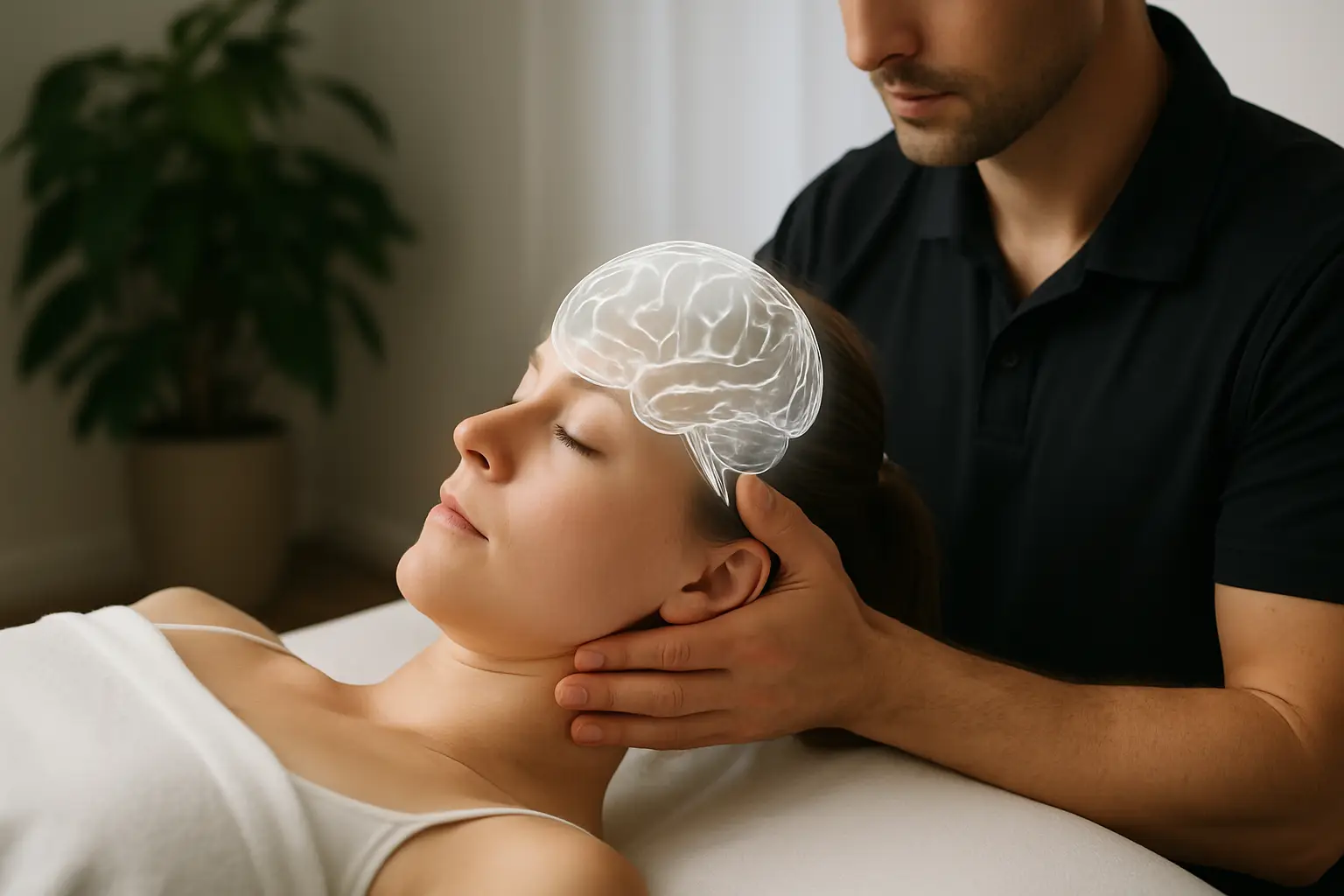
Neurocentric massage therapy is a way of working with the body that treats pain and tension as outputs of the brain and nervous system, not just a local tissue problem. It still uses skilled hands-on techniques – deep tissue when appropriate, lighter work when that is what your system can actually receive – but it organizes the whole session around one central question: what is your nervous system asking for right now, and what inputs will change its output?
What “neurocentric” means in massage therapy
“Neurocentric” is not a brand-new technique so much as a clinical lens. Instead of assuming a tight muscle needs to be forced to lengthen, a neurocentric approach starts by considering why the nervous system is guarding in the first place.
Pain, muscle tone, and range of motion are regulated by your nervous system moment-to-moment. If your brain perceives threat – from stress, poor sleep, a recent injury, an old injury, or simply too much training load without enough recovery – it can increase protective output. That output can look like tension, reduced mobility, tenderness, headaches, jaw clenching, or a “stuck” feeling that does not match what you see on an MRI.
This is why two people can have the same “knot” in the upper trap and have totally different needs. One person improves with targeted pressure and movement. Another person flares for days if you go in hard. The tissue is not the whole story; the nervous system’s tolerance matters.
Why some bodies “fight” massage – and what that’s telling you
If you have ever felt like your body braces during treatment, that is information, not failure. Bracing is a protective reflex. It can show up as holding your breath, tightening the glutes, curling the toes, or feeling restless on the table. It can also show up later as a spike in soreness, headaches, fatigue, or disrupted sleep.
Sometimes the issue is simply dosing: too much pressure, too much intensity, too much time in one area. But sometimes it is context. If your nervous system is already running hot (high stress, poor recovery, pain anxiety, sensory sensitivity), even technically “good” manual therapy can land as more threat.
A neurocentric massage session treats these signals as guideposts. The goal is not to prove how much pressure you can tolerate. The goal is to find the entry point that your system recognizes as safe enough to change.
The mechanisms: how neurocentric work can change pain
The most useful way to think about massage is as sensory input. Pressure, stretch, skin glide, joint motion, temperature, and pacing are all inputs that your nervous system integrates. When the inputs are well chosen, they can influence outputs like muscle tone, perceived pain, and movement confidence.
A neurocentric approach often focuses on three overlapping mechanisms.
First is downregulation: shifting you out of fight-or-flight and into a calmer state where tissues can soften and breathing can deepen. That might involve slower pacing, diaphragmatic breathing cues, broad contact, or craniosacral-style stillness depending on what your system responds to.
Second is improved motor control and range of motion. When the nervous system feels safe, it often allows more movement. You may notice that your shoulder lifts easier or your jaw opens with less resistance – not because the therapist “broke up” anything, but because the guard has lowered.
Third is graded exposure to sensation. For some people, the path out of chronic pain is not avoiding sensation, and it is not bulldozing through it either. It is building tolerance. That can mean starting with lighter work and gradually adding depth, speed, or specific trigger point pressure as your system demonstrates it can process it.
It depends on the person. Neurocentric does not mean “always gentle,” and it does not mean “deep tissue is bad.” It means intensity is selected based on nervous system response, not therapist preference.
What a neurocentric massage therapy session looks like
From the outside, a neurocentric session can look like a regular clinical massage appointment. The difference is the structure and the feedback loops.
It usually starts with a brief assessment that goes beyond “where does it hurt?” You might talk about how the pain behaves across the day, what aggravates it, what relieves it, sleep quality, training volume, stress level, and prior injuries. This is not small talk. It helps predict irritability and choose an appropriate dose.
During hands-on work, the therapist watches for signs of guarding and tracks your breathing, tissue response, and verbal feedback. Pressure is adjusted frequently. If your nervous system settles, the work may get more specific – for example, blending myofascial release with targeted trigger point therapy. If your system ramps up, the therapist may widen the contact area, slow down, change position, or switch techniques.
Many neurocentric sessions blend orthopaedic and relaxation components intentionally. For a desk-bound professional with neck tension and tension headaches, that might mean focused work to the suboccipitals, jaw, and upper thoracic area, followed by slower Swedish-style downregulation to consolidate the change. For an athlete, it might look like specific hip and calf work paired with parasympathetic-focused pacing so recovery can actually happen.
Trauma-informed care is part of being neurocentric
If the nervous system is central, then safety is central. A trauma-informed approach is not only for people with a known trauma history. It is good clinical care for anyone whose nervous system is protective.
Practically, that looks like clear consent, predictable transitions, and ongoing choice. You should feel able to say, “That’s too much,” or “Can we skip that area today?” without being judged. You should also feel like the therapist is reading your body as well as listening to your words.
For many clients, especially those who have felt dismissed in healthcare settings, the ability to set boundaries is not a “nice-to-have.” It is part of what allows the nervous system to downshift.
Who neurocentric massage therapy tends to help most
This approach is often a strong fit if your symptoms are persistent, stress-reactive, or inconsistent.
Clients with tension headaches, jaw clenching and TMJ discomfort, chronic neck and shoulder tightness, or low back stiffness that fluctuates with workload often do well because the treatment addresses both tissue and the stress-tension loop.
It is also useful for athletes who are doing “all the right things” but still feel stuck: mobility plateaus, recurring strains, or that sense of constantly being on the edge of injury. Sometimes the missing variable is recovery signaling – teaching the nervous system that it is allowed to shift out of high alert.
And for people who do not tolerate deep work well, neurocentric care can be the difference between dreading appointments and finally finding a pressure and pace that create change without a flare.
Trade-offs and what neurocentric massage is not
There are trade-offs. If you want a set, one-size-fits-all deep tissue routine every time, a neurocentric approach may feel less predictable, because it adapts to what your system is doing that day.
It also is not a promise of instant results. Some bodies shift quickly. Others need a few sessions of graded work and home support (sleep, hydration, movement snacks, stress management) before changes hold.
And it is not a replacement for medical evaluation when red flags are present. Progressive neurological symptoms, unexplained weight loss, fever, night pain that is not mechanical, or new bowel or bladder changes deserve timely medical attention.
Choosing a provider: what to listen for
If you are looking for neurocentric massage therapy in a clinical setting, pay attention to how the therapist talks about pressure and outcomes. A good sign is a provider who discusses assessment, nervous system tolerance, and pacing – and who is comfortable using both deeper orthopaedic techniques and gentler downregulation tools.
You can also notice how they talk about your role. Neurocentric care is collaborative. The therapist is the expert in manual therapy and clinical reasoning, but your feedback is essential data.
At [Reset Registered Massage Therapy](https://resetrmt.ca), that collaboration shows up as a structured, evidence-based session that blends targeted orthopaedic work with nervous-system downregulation in a safe, inclusive, non-judgmental space.
If you are unsure whether an approach is right for you, a simple starting question helps: “If my body guards or I feel sore for days after massage, how will you adjust the plan?” The answer tells you whether the provider is thinking neurocentrically.
A helpful closing thought: the most effective massage is rarely the one that hurts the most – it is the one your nervous system can actually integrate, so relief is not just immediate, but repeatable.
Pingback: Registered Massage Therapy Benefits That Matter - Reset Registered Massage Therapy
Pingback: What Is Registered Massage Therapy, Really? - Reset Registered Massage Therapy
Pingback: Deep Tissue Massage for Athletes: What Works - Reset Registered Massage Therapy
Pingback: Intraoral TMJ Massage Therapy: What to Expect - Reset Registered Massage Therapy
Pingback: Can Massage Calm a Stuck Stress Response? - Reset Registered Massage Therapy