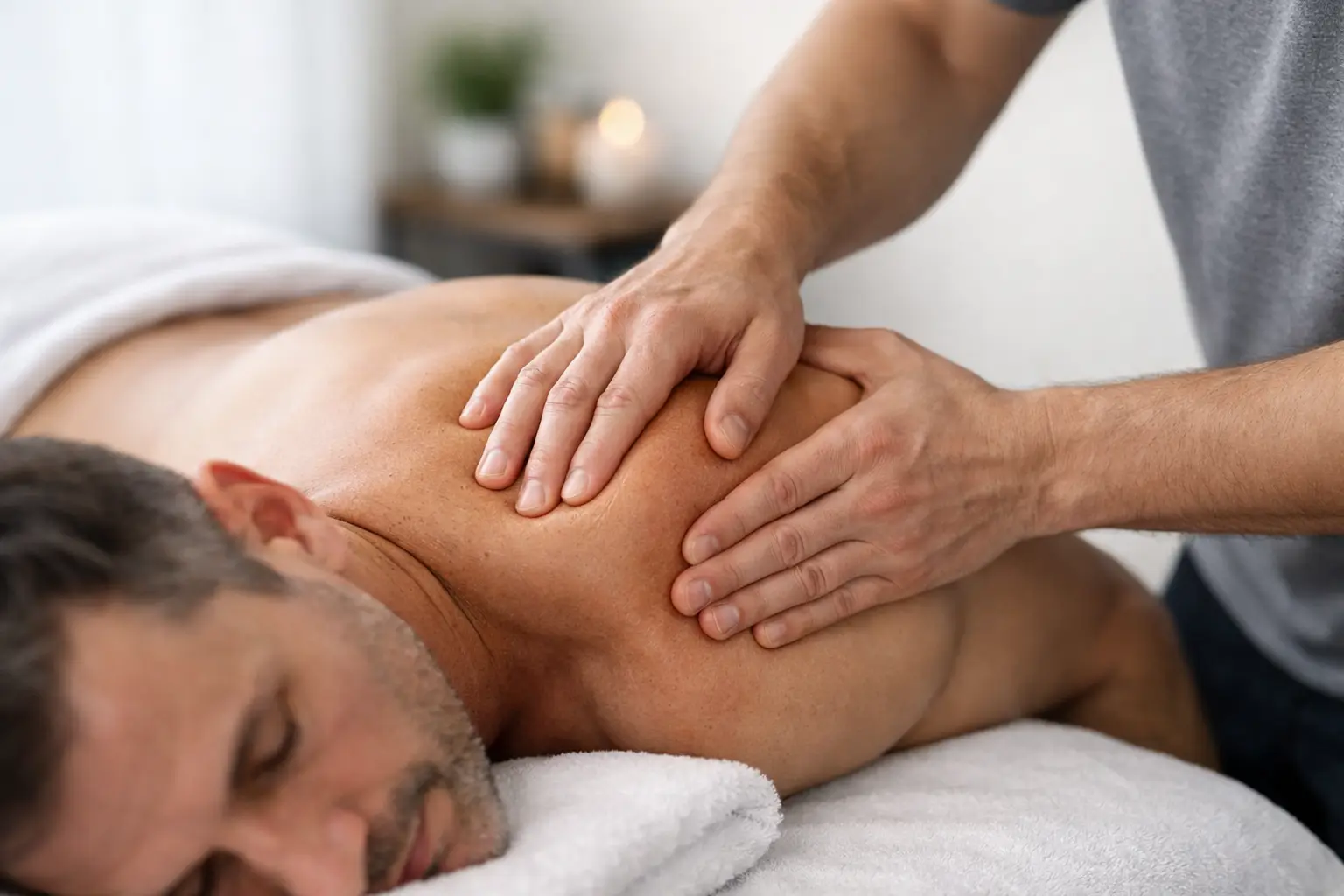
That sharp catch when you reach overhead, pull on a jacket, or lower a bag from a shelf often gets labeled as a “tight shoulder.” In many cases, though, the problem is more specific, and massage for rotator cuff tendinopathy works best when it is treated that way. A sore rotator cuff is not just a knot to press out. It is usually a load-sensitive tendon issue shaped by movement habits, training volume, posture, sleep position, stress, and how guarded the nervous system has become.
This is where good massage therapy can help, and where generic shoulder work can miss the mark. Tendons do not respond well to being attacked. They tend to respond better to treatment that improves comfort, settles protective muscle tension, restores shoulder mechanics, and makes exercise or daily movement easier to tolerate.
What rotator cuff tendinopathy actually is
Rotator cuff tendinopathy refers to irritation or overload in one or more of the rotator cuff tendons, most often around the supraspinatus, infraspinatus, subscapularis, or teres minor. These tendons help center the shoulder joint and control arm movement, especially during lifting, reaching, and lowering.
For some people, symptoms build slowly. You may notice pain with side lying, reaching behind your back, pressing weight overhead, or doing repeated desk and mouse work without much variation. For others, it starts after a spike in training load, a return to the gym, or a weekend project that involved more lifting than usual.
The key detail is that tendinopathy is not simply inflammation in the usual sense, and it is not always a sign of tissue damage that needs total rest. More often, it reflects a tendon that is struggling to keep up with demand. That is why treatment usually works best when it balances symptom relief with gradual reloading.
Can massage for rotator cuff tendinopathy help?
Yes, often – but not because massage “heals” the tendon directly in isolation. The better question is what massage changes around the problem.
Massage for rotator cuff tendinopathy can reduce pain sensitivity, decrease protective muscle guarding, improve tolerance to movement, and help the shoulder blade, neck, chest, and upper arm work together with less friction and less effort. When pain has been present for a while, people often stop moving normally. The upper traps grip. The pecs shorten. The deltoid overworks. Sleep becomes lighter. Stress climbs. That pain-tension-stress loop matters.
Well-delivered massage can interrupt that loop. It may help you turn your head without bracing, lift the arm with less apprehension, or tolerate the strengthening work that actually builds long-term capacity. That does not mean deeper is better. In fact, excessive pressure over a reactive tendon can flare symptoms and make the shoulder feel worse for a day or two.
What good treatment should focus on
A clinical massage approach for shoulder pain should start with assessment, not assumptions. Pain at the front or side of the shoulder can come from the rotator cuff, but it can also involve the biceps tendon, the AC joint, the neck, referred pain from trigger points, or stiffness in the thoracic spine and rib cage.
That is why treatment should be responsive. The shoulder is rarely treated well by focusing on one sore spot alone. Depending on your presentation, the session may include work to the posterior cuff, deltoid, pectorals, lats, upper trapezius, levator scapulae, or the tissues around the shoulder blade. Myofascial release and trigger point therapy can be useful when they are applied with clear intent and within your tolerance. Gentler work may be the better choice if the nervous system is already on high alert.
A trauma-informed, safety-centered approach also matters more than many people realize. If your shoulder has been painful for months, your body may react to pressure quickly. Consent, pacing, communication, and the option to adjust pressure are not extras. They are part of effective treatment.
What massage can and cannot do
Massage can be excellent for short-term pain reduction and for improving how the shoulder feels and moves in the moment. It can also support better sleep, less guarding, and a stronger starting point for exercise-based rehab.
What it usually cannot do on its own is create lasting tendon capacity. Tendons adapt to progressive loading. That means if your shoulder is irritated by pulling, pressing, throwing, swimming, or repetitive reaching, rehab exercises are often part of the answer. Isometrics, controlled external rotation work, scapular strength, and gradual return to overhead tasks are common pieces of a plan.
This is the trade-off some people need to hear clearly. If you want only passive care, massage may provide relief but not enough change to keep symptoms from returning. If you combine massage with well-timed exercise and activity modification, outcomes are often better.
When massage for rotator cuff tendinopathy is most useful
Massage tends to be especially helpful when the shoulder is painful enough that everything around it has started tightening up. This often shows up as neck tension, mid-back stiffness, pain down the upper arm, or a sense that the whole shoulder girdle feels jammed.
It can also help when you are trying to stay active without constantly provoking symptoms. Runners who swing one irritated arm awkwardly, office workers who brace at the keyboard, and lifters who cannot find a comfortable pressing pattern may all benefit from a treatment approach that improves movement quality while calming the system down.
In a setting like Reset Registered Massage Therapy, that often means blending orthopedic precision with a strong relaxation component rather than forcing a deep tissue session from start to finish. For some clients, that shift is what finally lets the shoulder stop guarding.
Signs your shoulder needs more than massage
Not every shoulder issue belongs solely in a massage treatment room. If pain is severe after a fall, you have significant weakness, you cannot lift the arm, there is obvious deformity, or numbness and tingling are spreading into the hand, a medical evaluation is important.
The same applies if night pain is intense and unrelenting, or if symptoms are not improving at all despite modified activity and appropriate care. Massage therapy fits best as part of a wider clinical picture, not as a substitute for assessment when red flags are present.
What a session should feel like
A good session for rotator cuff tendinopathy should feel specific, collaborative, and measured. You should understand why certain tissues are being treated and why others are being left alone. Pressure should be adjusted based on irritability, not ego. If a technique causes you to brace, hold your breath, or feel threatened by the sensation, that is usually not the right dose.
After treatment, many clients feel lighter through the neck and upper back, freer in overhead reach, and less sharp pain with daily tasks. Some post-treatment soreness can happen, especially if tissues have been guarding for a long time, but a major flare is not a sign of effective care.
The role of home care
The simplest home care is often the most useful. Relative rest does not mean total rest. It means reducing aggravating volume for a short window while keeping the shoulder moving in tolerable ranges. That may involve changing sleep setup, avoiding repeated painful overhead work for a few days, or temporarily reducing pressing volume at the gym.
Small, consistent exercises usually matter more than heroic stretches. If a stretch reproduces the same pinching pain you are trying to calm down, it may not be helping. A better plan is often gentle range of motion, light isometric loading, and gradual strengthening that respects pain but does not fear all discomfort.
Choosing the right kind of massage therapist
If you are seeking massage for rotator cuff tendinopathy, look for a practitioner who assesses before treating, explains their reasoning, and adapts to your response in real time. Shoulder pain can be stubborn, and a one-size-fits-all deep tissue routine is rarely ideal.
The best care usually comes from someone who can think clinically without treating you like a diagnosis on a chart. That means understanding tendon load, movement patterns, and referred pain, while also creating a safe, non-judgmental experience where your body can stop fighting the process.
Shoulder pain can make ordinary tasks feel strangely complicated. The goal of treatment is not just to press on sore tissue. It is to help you move with more confidence, less guarding, and a clearer path back to the things your shoulder needs to do.