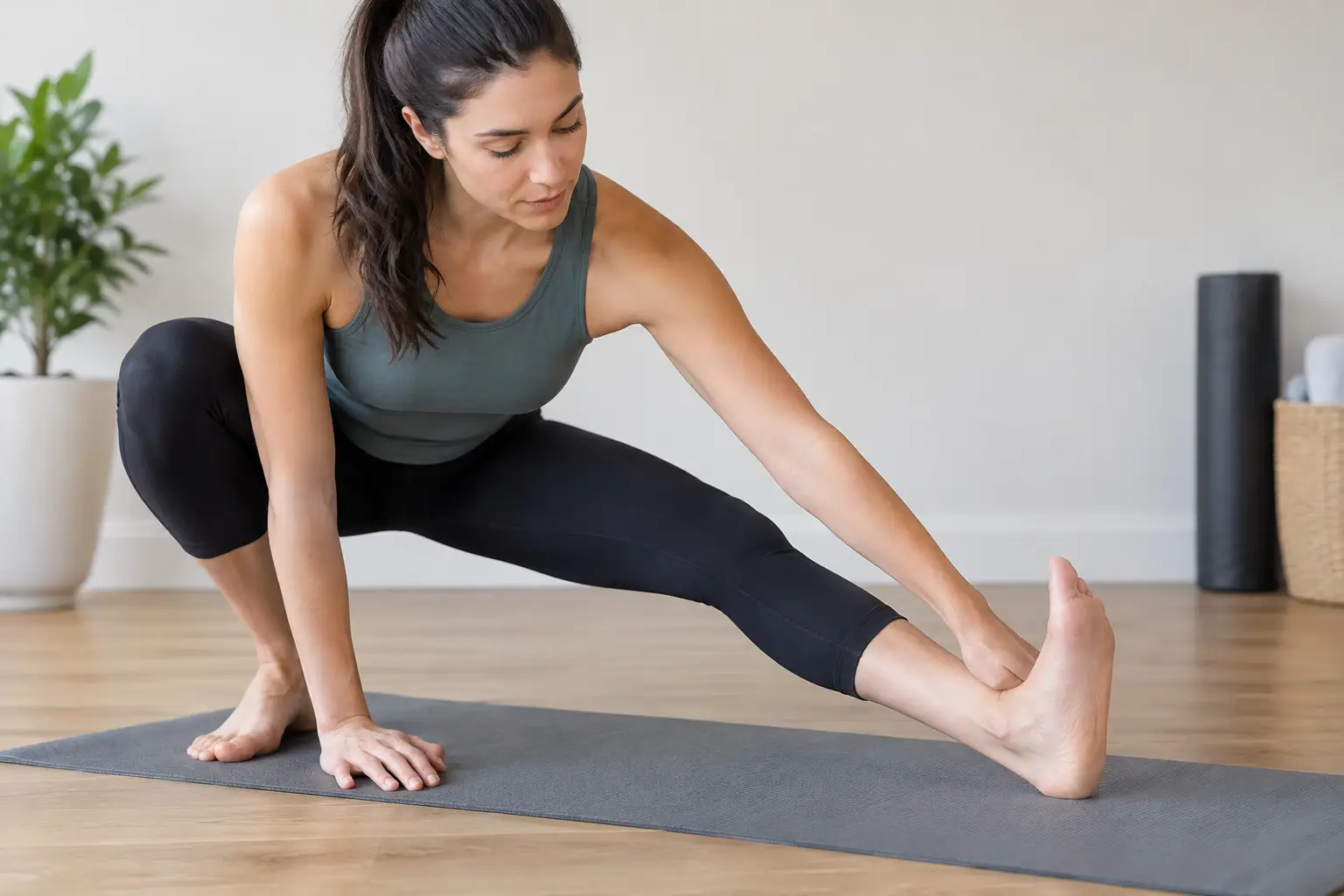
Your ankles quietly manage a remarkable amount of force every time you walk downstairs, squat to pick something up, run for the bus, or land from a jump. When they do not move well, the body usually finds a workaround: heels lift in a squat, knees turn inward, feet flare outward, or the hip and low back take on more motion than they should. Learning how to improve ankle mobility is less about pushing harder into a stretch and more about identifying what is limiting movement, then building comfortable control through that range.
For many people, ankle stiffness is not simply a “tight calf” problem. It can reflect a past sprain, joint irritation, swelling, protective muscle tension, limited foot strength, training load, or a nervous system that has learned to guard an area after pain. The most useful approach is individualized, gradual, and responsive to symptoms.
What ankle mobility actually means
Most conversations about ankle mobility refer to dorsiflexion: the ability to bring the top of the foot toward the shin. You use dorsiflexion when your knee travels forward over your foot during a squat, lunge, stair descent, or walking stride. Limited dorsiflexion can make everyday movement feel awkward and may change how load is distributed through the foot, knee, hip, and lower back.
The ankle is not working alone. The talocrural joint between the shin and ankle bones needs to glide, while the calf muscles, Achilles tendon, foot muscles, and tissues around the joint need to tolerate length and load. Your big toe also matters. If the big toe cannot extend well, your body may alter the way it rolls through the foot and ankle while walking or running.
Mobility is therefore not the same as passive flexibility. Being able to pull your foot farther with a strap does not necessarily mean you can control that position while carrying groceries, hiking downhill, or lifting weights. A useful goal is enough range for your activities, paired with strength, balance, and confidence.
How to improve ankle mobility with a simple assessment
Before adding stretches, get a baseline. The knee-to-wall test is a practical screen that does not require special equipment. Stand facing a wall with one foot flat on the floor. Keeping the heel down and the knee aligned roughly over the second or third toe, gently bring the knee toward the wall. Slide the foot back a little at a time until the knee can just touch the wall without the heel lifting or the arch collapsing.
Measure the distance from your big toe to the wall, or simply compare sides. Many active adults can reach somewhere around 3 to 5 inches, but there is no single number that defines a healthy ankle. The more meaningful information is whether one side is substantially different, whether the test causes pain, and whether your range is sufficient for what you want to do.
Pay attention to the quality of the sensation. A mild calf stretch or firm pressure at the front of the ankle may be tolerable. Sharp pain, pinching, giving way, numbness, or swelling are different signals. Do not force through them in an attempt to gain range.
Start with controlled movement, not aggressive stretching
When an ankle feels stiff, long static stretching can sometimes help, particularly if the calf muscles are truly short or deconditioned. But stretching alone often produces a short-lived change. Controlled, repeated movement gives your nervous system evidence that the range is safe and usable.
Try these drills three to five days per week. They should feel like focused work, not a test of willpower. Start with one or two drills, especially if you are returning after injury or managing a sensitive joint.
Knee-over-toe rocks
Stand in a staggered stance near a wall or counter for support. Keep the working foot flat, then slowly guide the knee forward over the middle toes. Pause briefly before returning to the start. Keep the movement smooth and let the heel remain heavy on the floor.
Perform 8 to 12 repetitions for two or three sets. This is a useful option before a walk, run, lower-body workout, or a day that involves long periods of sitting. The goal is not to make the knee travel as far as possible. The goal is a calm, controlled motion without collapse, gripping, or pain.
Bent-knee calf raises
A straight-knee calf raise emphasizes the gastrocnemius, while a bent-knee version places more load on the soleus, a deeper calf muscle that is especially relevant for walking, running, and ankle dorsiflexion. Hold a counter, bend the knees slightly, rise onto the balls of both feet, then lower slowly for about three seconds.
Aim for 8 to 15 repetitions. As this becomes easier, progress toward single-leg work. Strengthening the calf through a comfortable range can be more helpful than repeatedly stretching a muscle that is already working hard to stabilize an irritated ankle.
Heel-elevated squat holds
Place your heels on a small, stable wedge, weight plate, or firmly folded towel. Lower into a shallow squat that feels controlled, keeping your feet connected to the floor. Hold for 15 to 30 seconds while breathing normally.
This variation lets you practice a squat pattern while reducing the dorsiflexion demand. Over time, use a slightly smaller heel lift or work toward the same depth with flat feet, provided your knees, hips, and ankles remain comfortable. It is a practical bridge for people whose ankles limit their squat mechanics.
Supported single-leg balance
Stand near a wall or counter and balance on one foot for 20 to 30 seconds. Keep a soft knee, let the toes stay relaxed, and notice whether the foot can make small adjustments without gripping. Repeat two or three times on each side.
Balance training does not create range by itself, but it improves the coordination that makes new range useful. This is particularly valuable after an ankle sprain, when joint position awareness can be affected even after swelling and bruising have resolved.
Pair mobility work with the activity that exposes the limitation
The best plan depends on what ankle mobility is stopping you from doing. A runner who feels stiff at the start of a run may benefit from ankle rocks, bent-knee calf raises, and a gradual warm-up. Someone whose heels lift during a squat may need to assess squat depth, footwear, hip control, and their tolerance for load rather than chase maximum ankle range.
For hikers and people who walk Vancouver’s hills or spend long shifts on their feet, downhill tolerance can be the limiting factor. Slow calf-lowering exercises and step-downs may be more relevant than stretching. For court athletes, lateral control and landing mechanics deserve as much attention as dorsiflexion. The body responds to specific demands.
Footwear can also change the picture. A higher-heeled shoe reduces the amount of ankle dorsiflexion required, which can offer temporary comfort but may conceal a limitation. Minimal shoes increase the demand on the ankle and foot. Neither category is universally better. A gradual transition and an honest assessment of your current capacity matter more than a trend.
When stiffness may need a clinical assessment
Some ankle restrictions respond well to consistent home exercise. Others need a closer look. An assessment is appropriate if stiffness began after a significant sprain, fracture, surgery, or period of immobilization; if you have persistent swelling; if the ankle repeatedly gives way; or if there is sharp pain at the front, side, or back of the joint.
Seek timely medical care after a new injury if you cannot bear weight, there is visible deformity, severe swelling, numbness, color change, fever, or increasing pain. These are not situations to self-treat with mobility drills.
Even without a recent injury, recurring ankle discomfort can be worth assessing when it changes your gait, limits work or exercise, or contributes to knee, hip, or low-back symptoms. A clinician can consider joint mechanics, tissue tolerance, prior injuries, footwear, training volume, and movement patterns. Evidence-based manual therapy may offer short-term symptom relief or help prepare an area for movement, but lasting progress generally comes from pairing hands-on care with appropriate loading and active exercise.
At Reset Registered Massage Therapy, treatment is guided by assessment and ongoing client feedback rather than a standardized sequence. For an ankle that feels guarded or overloaded, that may include targeted soft-tissue work around the calf and foot, while respecting tolerance, consent, and the broader factors affecting movement. The aim is not to force a joint into range, but to support a body that can move with less threat and more options.
Give your ankles enough time to adapt
Changes in ankle mobility are rarely dramatic from one session to the next. A few minutes of well-chosen movement performed consistently usually outperforms an occasional, intense stretching session. Track functional markers instead: a more comfortable stair descent, less heel lift in a squat, a smoother walking stride, or greater confidence on uneven ground.
If a drill leaves the ankle more than mildly sore for longer than a day, reduce the range, repetitions, or frequency. Progress is allowed to be quiet. The most effective ankle work is the work your body can tolerate, repeat, and gradually trust.