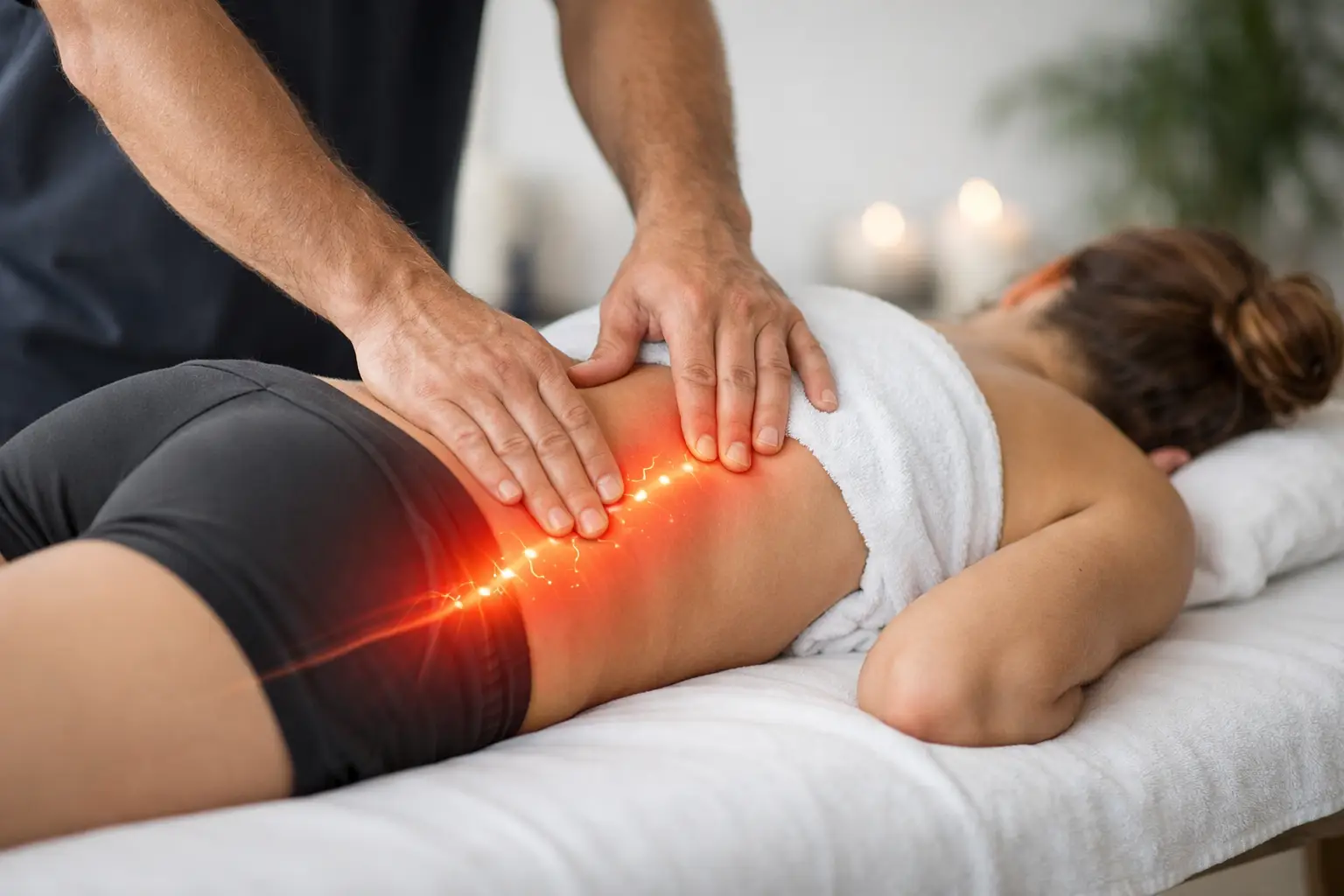
Sciatica rarely feels simple when you are the one dealing with it. The pain may start in the low back or glutes, then travel down the leg as aching, burning, tingling, or sharp nerve-like discomfort. For many people, massage therapy for sciatica symptoms can help, but the real question is not whether massage is “good” or “bad” for sciatica. It is whether the treatment is skilled, well-timed, and adapted to the way your body is presenting on that particular day.
Sciatica is a symptom pattern, not a single diagnosis. That matters because two people can both say they have sciatica and need very different care. One person may have irritated tissues around the hip and deep glutes that are contributing to nerve sensitivity. Another may have lumbar disc involvement, limited tolerance for pressure, and symptoms that flare when lying flat. Good treatment starts by respecting those differences rather than applying the same routine to everyone.
What sciatica symptoms actually involve
The term sciatica usually refers to pain, numbness, tingling, or altered sensation that follows the path of the sciatic nerve, often from the low back or buttock into the back of the thigh and sometimes the calf or foot. Some people feel a dull pull. Others describe electric pain, weakness, or a leg that feels unreliable.
That symptom pattern can be influenced by more than one structure. Lumbar joints and discs, the deep hip rotators, surrounding fascia, hamstrings, and the nervous system itself can all play a role. Stress also matters. When pain has been present for a while, the nervous system often becomes more protective. Muscles tighten, movement gets guarded, sleep gets worse, and the pain-tension-stress cycle becomes part of the problem.
This is one reason massage can be useful. Thoughtful hands-on treatment does not need to “fix” the nerve directly to be helpful. It can reduce muscular guarding, improve local circulation, support easier movement, and give the nervous system a clearer signal that it is safe to dial down some of that protection.
How massage therapy for sciatica symptoms may help
Massage is most effective for sciatica symptoms when it is precise rather than aggressive. In many cases, the goal is not to push hard into painful tissue. The goal is to assess which muscles and connective tissues are overworking, which positions calm symptoms, and what kind of input your system can tolerate without flaring.
Targeted work around the glutes, hip rotators, lower back, and posterior thigh may reduce tension that is adding compression or irritation around the area. Myofascial release can be helpful when tissue feels restricted and movement is guarded. Trigger point therapy may help if there are distinct referral patterns through the glutes or hamstrings. Swedish-style techniques can also play an important role, especially when your symptoms are being amplified by stress, poor sleep, or a highly wound-up nervous system.
That mix of clinical treatment and downregulation is often where people notice the biggest difference. When the body is bracing less, walking, sitting, and changing positions can feel easier. Pain may not disappear in one session, but it often becomes less intense, less constant, or less reactive.
When massage helps most – and when it depends
Massage tends to help most when sciatica symptoms are being maintained by muscle guarding, hip and low back stiffness, overuse, training load, prolonged sitting, or a sensitized nervous system. Office workers, commuters, runners, lifters, and active people often fall into this category. They are not always dealing with a major structural injury, but their tissues are overloaded and their system is stuck in protection mode.
It depends more when symptoms are severe, highly irritable, or paired with major neurological changes. If coughing or sneezing sharply increases pain, if the leg is giving out, or if symptoms are rapidly worsening, massage may still be part of care later, but it should not be the first or only step. The same is true if pressure, stretching, or lying in certain positions creates a strong flare-up. In these cases, treatment has to be especially cautious and often works best as part of a broader plan.
Massage is also not a substitute for medical evaluation when there are red flags. New bowel or bladder changes, saddle numbness, unexplained severe weakness, fever, unexplained weight loss, or pain after significant trauma need prompt assessment.
What a skilled session should look like
If you are seeking massage therapy for sciatica symptoms, the quality of assessment matters as much as the hands-on work. A therapist should ask where the symptoms travel, what movements aggravate them, whether the pain is constant or intermittent, and how your tolerance changes from day to day. They should also pay attention to comfort, positioning, pressure, and consent throughout the session.
That process is especially important because more pressure is not always better. With nerve-related pain, an overly forceful approach can increase guarding instead of reducing it. Sometimes the body responds better to slower, more specific work around the hip, sacral area, low back, and lateral thigh rather than direct, intense pressure into the most painful spot.
A trauma-informed, safety-centered approach matters here too. Pain changes how people feel in their bodies. If you are already bracing, uncertain, or worried that treatment will make things worse, your system may stay on alert. Clear communication, the ability to modify pressure, and an inclusive, non-judgmental environment are not extras. They are part of effective care.
What you may feel after treatment
After a well-paced session, people often notice one of a few patterns. Some feel immediate relief, especially if the main driver was muscular tension and limited movement. Others notice they can sit, walk, or turn more easily even if the leg symptoms are still present. Some feel tired or slightly tender for a day, then improve as the body settles.
A short-term increase in awareness is possible, but a major flare is not the goal. If treatment leaves you significantly worse for several days, the pressure, positioning, or technique may have been too much for your current tolerance. Sciatica care should be responsive, not fixed.
Why combining orthopedic thinking with relaxation works
People with sciatica are often caught between two extremes. On one side is generic relaxation massage that feels nice but does not meaningfully address the movement problem. On the other is overly aggressive deep tissue work that treats every symptom as a knot to be broken up. Neither is ideal.
A better approach blends orthopedic reasoning with nervous-system regulation. That means looking at hip mechanics, lumbar loading, activity patterns, and referred pain patterns while also recognizing that pain is influenced by stress, fatigue, and threat perception. Clinical precision matters, but so does helping the body feel safe enough to stop fighting every touch and every movement.
This is where personalized registered massage therapy can be valuable. At Reset Registered Massage Therapy, sessions are designed around both tissue presentation and nervous-system state, which is often exactly what persistent sciatica symptoms require.
Getting the best results between sessions
Massage works better when it is part of a larger pattern of support. That does not mean you need an elaborate rehab program. Often, small changes make the difference. Breaking up long periods of sitting, using movement that eases rather than aggravates symptoms, and avoiding the urge to stretch aggressively into nerve pain can all help.
It is also useful to pay attention to your symptom behavior instead of forcing a rule. Some people feel better walking. Others need shorter walks and more frequent position changes. Some respond well to gentle mobility work. Others need to calm irritation first. Good care is less about pushing through and more about reading what your system tolerates.
If your sciatica symptoms have been lingering, becoming more frequent, or interfering with work, training, or sleep, hands-on care may be worth considering, especially when it includes assessment, adaptive pressure, and a plan built around your actual presentation rather than a standard routine.
The most helpful treatment is often the one that meets your body where it is – not where you wish it were – and gives it enough skilled input, clarity, and calm to start moving out of protection.